From Weakness to CVE: Understanding How Bugs Become Global Vulnerabilities
The path from discovering a software flaw to classifying it under CVE and CWE.
Introduction
Every serious vulnerability starts as a hunch — a strange log entry, an unexpected response, or a small function that behaves oddly. But how does that private observation become a CVE, something the entire cybersecurity world tracks and patches?
This post walks through the real-life process of identifying, classifying, and responsibly disclosing vulnerabilities — focusing on the bridge between CWE (the root weakness) and CVE (the recorded instance). It’s the anatomy of a bug’s journey from “weird behavior” to “public vulnerability.”
1. The Spark: Recognizing a Weakness
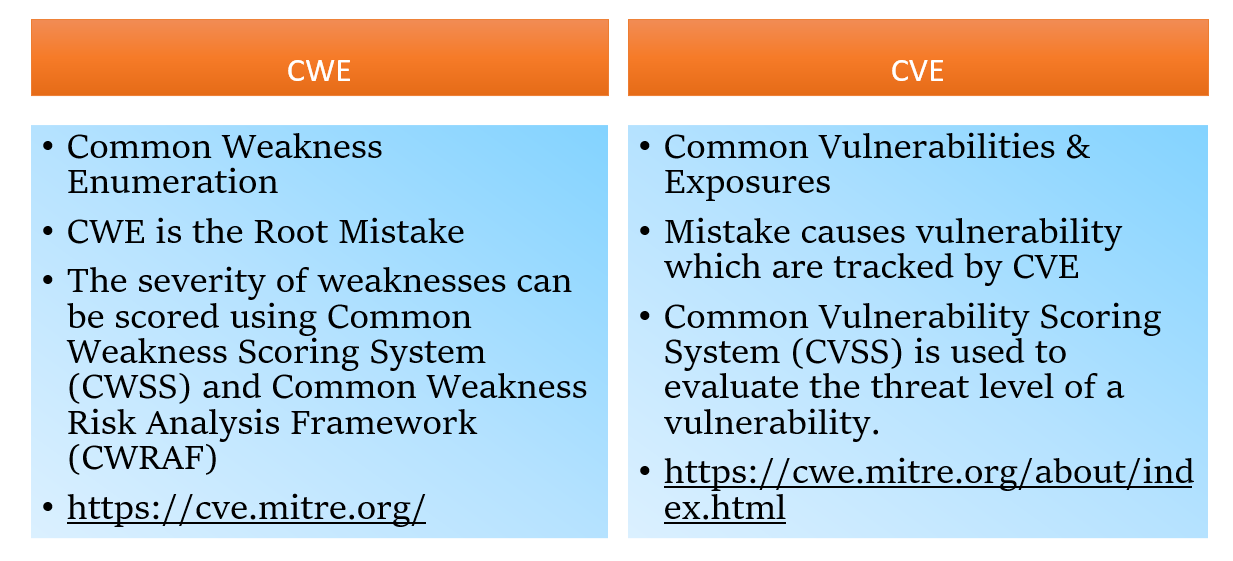
Before a CVE exists, there’s a CWE — the type of weakness. Think of CWE as the “family tree” of bugs, defining why something is insecure.
Some examples of classic CWEs:
- CWE-79: Cross-Site Scripting (XSS)
- CWE-89: SQL Injection
- CWE-502: Unsafe Deserialization
- CWE-787: Out-of-Bounds Write
- CWE-269: Improper Privilege Management
Recognizing which CWE you’re dealing with helps define how severe the issue is, how it might be exploited, and who needs to fix it.
Example scenario (safe illustration): A web API allows file uploads without proper filename sanitization. When analyzing, you notice user-controlled filenames get concatenated directly into a file path. That’s CWE-22 (Path Traversal) — a well-known weakness pattern.
No need to exploit — identifying the pattern already gives you a CWE match.
2. Reproducibility and Evidence Gathering
To progress from CWE to CVE, you need clear, reproducible evidence that:
- The vulnerability exists in a specific software version.
- The behavior can be triggered by an attacker (even conceptually).
- The issue has security impact (confidentiality, integrity, or availability).
Evidence may include:
- Logs or debug outputs showing unintended behavior.
- Version numbers and affected configurations.
- Vendor documentation that contradicts actual behavior.
Tip: Always record environment details: OS, app version, patch level, and configuration files. A proper CVE submission demands exact reproducibility.
3. Classification: CWE → CVSS → CVE
Once you confirm the weakness, classify it systematically:
a. CWE (Root Cause): Define what kind of bug it is — e.g., CWE-79 for an unsanitized parameter.
b. CVSS (Severity Scoring): Use the CVSS v3.1 base metrics to estimate severity:
- Attack Vector (AV)
- Attack Complexity (AC)
- Privileges Required (PR)
- Impact (CIA: Confidentiality, Integrity, Availability)
Example:
If an attacker can perform a reflected XSS without authentication —
AV:N / AC:L / PR:N / UI:R / S:C / C:L / I:L / A:N → CVSS 6.1 (Medium)
c. CVE (Documented Instance): A CVE is assigned once a vendor or CNA (CVE Numbering Authority) verifies and records your report.
4. The CVE Submission Path
To get a CVE, you don’t submit directly to MITRE (usually). You report it to the vendor or a CNA responsible for that software.
The process typically looks like this:
- Identify vendor or maintainer contact.
Usually
security@vendor.comor a bug bounty platform. - Submit a responsible disclosure report. Include proof, CWE classification, and severity estimate.
- Vendor confirms and requests a CVE ID.
- CNA or MITRE assigns a CVE number.
- Public disclosure once the patch is available.
If the vendor lacks a CNA, you can request assignment via MITRE’s official CVE request form — but only after coordination and confirmation.
5. Real Case Study (Conceptual Example)
Let’s simulate a safe, real-world-style example:
A researcher notices a web server plugin (say, a file-sharing plugin for a CMS) doesn’t properly restrict path traversal.
The researcher verifies that ../../ sequences are not sanitized, allowing unintended directory reads.
No exploitation, just a conceptual verification of behavior.
- CWE: CWE-22 (Improper Limitation of a Pathname to a Restricted Directory)
- CVSS: 7.5 (High)
- Impact: Confidentiality breach (reading arbitrary files)
- CVE outcome: Once confirmed by the vendor, the bug becomes something like CVE-2025-XXXX.
After the fix, a vendor advisory is published, linking to the CWE root cause and the CVE record.
6. Why CWE Mapping Matters for Every Researcher
Mapping to CWE improves more than just documentation — it teaches you how to think about vulnerabilities abstractly. When you understand CWE patterns, you start seeing bug classes, not just isolated issues.
For example:
- CWE-79 and CWE-80 both deal with XSS, but differ in reflection context.
- CWE-269 and CWE-266 both handle privilege issues, but differ in enforcement layers.
- CWE-502 (Deserialization) often pairs with CWE-94 (Code Injection) in real cases.
This abstraction makes your reports more professional and speeds up vendor triage.
7. Publishing and Ethics
Once the issue is verified and patched, researchers often publish:
- A technical advisory explaining the vulnerability class (CWE).
- A timeline showing discovery, vendor acknowledgment, patch release.
- A mitigation section describing safe configuration or patching methods.
Ethically, this ensures transparency while keeping exploitation details minimal — focusing on learning and prevention.
8. The Ecosystem View
Each CVE isn’t just a bug; it’s a node in a global web of knowledge. Security scanners, SIEM systems, and patch managers all rely on the CVE database. Meanwhile, CWEs form the taxonomic structure that helps researchers and developers understand why vulnerabilities happen in the first place.
Together, they’re a shared language between hackers, defenders, and vendors — the DNA of modern vulnerability management.
Conclusion
Understanding CVE and CWE transforms you from a bug finder into a vulnerability analyst — someone who not only spots flaws but understands their origin, classification, and lifecycle.
Next time you stumble across a weird behavior in software, pause before trying to exploit it. Classify it, document it, and trace it to a CWE. That’s how professional researchers turn isolated bugs into lasting security improvements.